

Kharkiv,
Gromadyanska St., 11/13
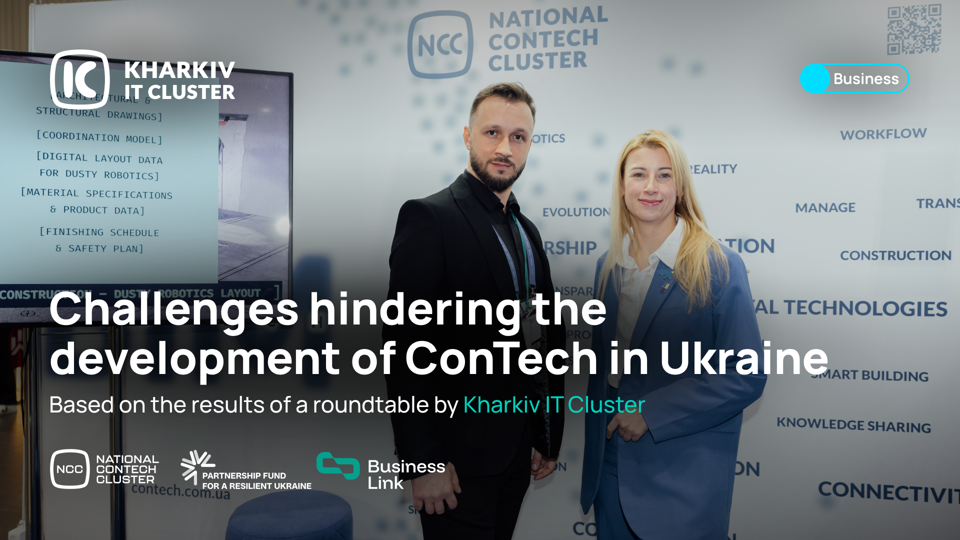
Construction Technologies (ConTech) sit at the intersection of IT and construction: BIM design, digital twins, analytics for developers, automation of tenders and logistics, new materials with calculated properties, and lifecycle management of buildings. These solutions are used by developers, design firms, contractors, and public authorities responsible for infrastructure.
Today, Ukraine’s construction sector is under pressure from multiple directions: large-scale reconstruction needs, limited resources, and international donors with strict transparency and compliance requirements. In this context, ConTech is no longer an “advanced option” — without digital tools, it’s simply impossible to manage complex projects at the required speed and scale.
Kharkiv IT Cluster and the National ConTech Cluster brought together IT companies, developers, and engineers to identify the real barriers in the sector. Here’s what’s holding the market back — and why none of these issues can be solved alone.
Problem 1. BIM Has No Legal Status
BIM is already used in Ukraine, but it is not formally recognized as a distinct activity in legislation. In practice, this means that including BIM in public procurement or international contracts is bureaucratically complicated — even when both sides want to work this way. The technology exists, the demand exists, but the legal framework does not.
Problem 2. The Talent Market Can’t Keep Up
BIM engineers and construction data analysts are niche specialists, and there are very few structured educational pathways in Ukraine. Universities are slow to adapt curricula to business needs, while businesses cannot afford to wait. As a result, companies either overpay for scarce talent or invest heavily in internal training — without systemic external support.
Problem 3. Lack of Common Standards
Without standardized technical approaches, every project starts from scratch: different methodologies, documentation, and processes. This increases both cost and timelines for all stakeholders. In large-scale reconstruction, where dozens of projects run in parallel, the absence of standards becomes a systemic bottleneck.
How Can Clusters Solve These Challenges?
All three problems share one key characteristic: they cannot be solved at the level of a single company.
A cluster is an объединення (association) of companies, organizations, and institutions within an industry that acts as a unified player with systemic influence.
How it works in practice:
- A unified voice in dialogue with the government. Public authorities respond to systemic requests, not isolated ones. A consolidated industry position carries significantly more weight and credibility.
- Trust from international partners. Donors and reconstruction programs are more willing to collaborate with structured industry alliances than with individual companies. For ConTech, this directly translates into access to funding and international markets.
- Faster implementation of solutions. Within a cluster, new products can be tested on real projects of member companies — eliminating the need for long, isolated pilot phases. This shortens the path from development to scaling.
- Standardization and process simplification. Clusters can develop typical technical solutions for recurring challenges and collectively work on simplifying regulatory processes.
Be Part of the Change
Ukraine’s ConTech sector already has both a strong technological foundation and real market demand. Ukrainian solutions are competitive globally — what’s missing is a systemic approach to overcoming scaling barriers. This is exactly where clusters come in.
If you work in IT, development, or engineering, join a cluster in your field and help shape the market together with those already building it.
👉 Join Kharkiv IT Cluster: https://it-kharkiv.com/join-company
👉 Become part of National ConTech Cluster: https://contech.com.ua/
This project is supported by the Partnership Fund for a Resilient Ukraine (PFRU), funded by aid from the governments of Canada, Estonia, Finland, Norway, Sweden, Switzerland, and the United Kingdom.
Read also
All news
Kharkiv IT Cluster is launching a new era of cooperation by signing a memorandum with the American non-profit organization TechHope Transitions Inc.The new international partner...
Читати повністю
Diia.Business is a support hub for the local business community, focused on entrepreneurship development and the digital transformation of small and medium-sized enterprises.Kha...
Читати повністю
Many entrepreneurs start their digitalization journey by searching for CRM, ERP, or other digital services. However, experts advise against rushing to choose software. The first...
Читати повністюSubscription to the email newsletter
Want to stay updated on the latest IT events in the region?
Subscribe to our newsletter!