

м. Харків,
вул. Громадянська, 11/13
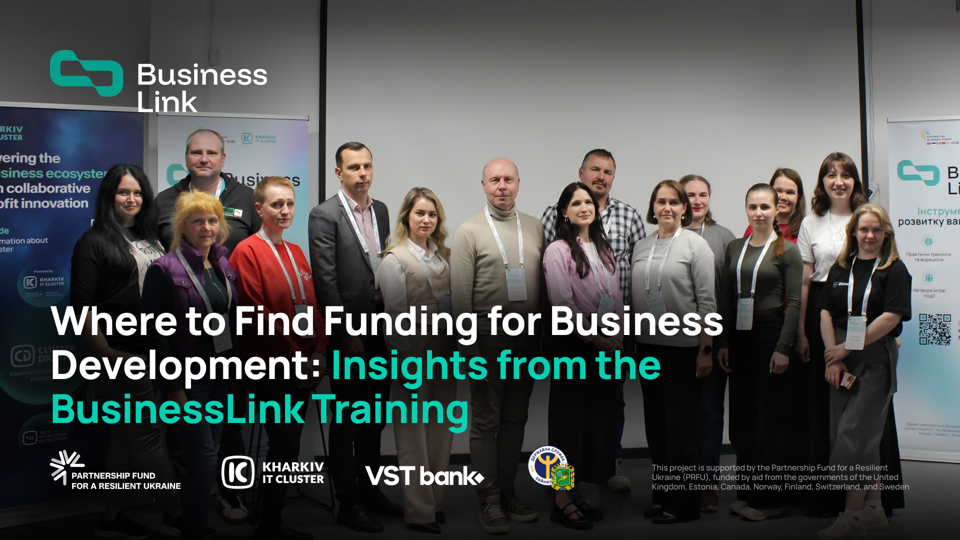
Grants, preferential loans and government programmes offer a range of opportunities to support and scale up your business, even in the most challenging circumstances.
On 28 May 2026, Kharkiv IT Cluster, as part of the BusinessLink project, held a practical training «Where to Find Funding for Business Development: Grants, 5-7-9% loans and other governmental programmes».
Entrepreneurs and representatives of small and medium-sized businesses explored how various support tools work, where to look for funding, and what mistakes to avoid when submitting applications.
Key takeaway: business support is not just about grants
Today, Ukrainian entrepreneurs have access to a wide range of tools: grants, preferential loans, government compensation programmes, business accelerators, mentoring support and technical assistance from international donors.
The most effective development model for businesses is to combine several tools simultaneously.
Where to Look for Grant Opportunities
Kateryna Kulakevych, Fundraising Manager at Kharkiv IT Cluster, advises monitoring current business support programmes via:
- specialised Telegram channels and portals;
- official pages of donor programmes;
- websites of international organisations and foundations.
«Entrepreneurs often spend a lot of time searching for programmes that aren’t suitable for them from the outset. Before preparing an application, it is important to carefully analyse the eligibility criteria and ensure that your company meets the programme’s requirements,» Kateryna noted.
The expert recommended asking five basic questions before submitting an application:
- Does the business meet the programme’s geographical criteria?
- Does the type of enterprise meet the donor’s requirements?
- Does the grant’s objective match the business’s actual needs?
- Is the company prepared to provide co-funding, if required?
- Will there be enough time and resources to implement the project?
Donors assess not only the idea itself, but also the enterprise’s ability to implement the project effectively. Therefore, Kateryna identifies the following as the most common reasons for rejection:
- a poorly defined problem;
- a lack of logic between the problem, the solution and the budget;
- inflated or unjustified costs;
- a lack of measurable outcomes;
- the use of boilerplate text without adapting it to the specific programme.
The Private Business Microgrant: What Applicants Should Look Out For
The Private Business microgrant programme remains one of the most popular tools for starting or scaling up a business. In the regions, the project is coordinated by regional employment centres, which can be contacted for advice.
Marina Prokhorenko, Deputy Head of the Project Implementation Department at the Kharkiv Regional Employment Centre, explained the key parameters of the programme.
The amount of funding depends on the scale of the project and the number of jobs created:
- up to 100,000 UAH – for registering a sole trader without the requirement to create new jobs;
- up to 300,000 UAH – provided one job is created;
- up to 500,000 UAH – provided two jobs are created.
Certain groups of applicants may be eligible for increased funding:
- up to 200,000 UAH – for young people aged 18–25 without the requirement to create jobs;
- up to 1 million UAH – for entrepreneurs in the field of pre-school education and creative industries (design, IT, advertising, publishing) subject to 30/70 co-financing;
- up to 1 million UAH – for veterans and members of their families.
Extended conditions are also provided for applicants from frontline regions.
What to Consider Before Submitting an Application
A significant proportion of rejections are not due to the business idea itself, but to a failure to meet the programme’s basic requirements.
Before submitting an application, you must check:
- whether the NACE codes comply with the programme’s conditions;
- whether the business is registered and operates in the correct territory;
- whether co-financing is available (if applicable);
- the list of eligible expenses.
For example, under the Private Business programme, funds may be used to purchase equipment and commercial vehicles, whilst certain categories of expenditure are subject to specific restrictions.
Lending under the Affordable Loans 5-7-9% programme
The Affordable Loans 5-7-9% preferential lending programme is one of the key instruments of state support for business, enabling the raising of funds for the development and recovery of enterprises through banks with the support of the President and the Government of Ukraine.
As of May 2026, entrepreneurs can obtain financing on the following terms:
- 15.69% per year – for replenishing working capital;
- 16.69–19.69% per year – for investment projects, depending on the business category.
Additional preferential mechanisms for interest rate compensation are in place for frontline areas. The funds can be used to purchase equipment, transport, property, or for the repair, construction or restoration of property damaged as a result of hostilities.
How to Prepare a Competitive Grant Proposal
A key factor for success is a logical project structure and the soundness of the proposed solutions.
An effective proposal is typically based on a logical sequence:
Problem – Solution – Implementation Plan – Budget – Expected Outcome
Each of these elements must be as specific as possible and supported by facts. Particular attention should be paid to the budget: all expenses must be directly related to the project’s objectives and supported by relevant calculations or commercial proposals.
What to do right away:
- compile a list of the business’s actual needs;
- determine which financing instrument best meets these needs;
- subscribe to reliable sources of information about grants and support programs;
- prepare a basic set of documents in advance.
Despite the variety of available support programs, successfully securing funding depends first and foremost on the business’s readiness to work with these opportunities.
We’re sharing an entrepreneur’s checklist before submitting a grant application via the link, and a complete list of support programs can be viewed on the Made in Ukraine website.
A recording of the training is available via the link.
This material was prepared based on the results of the BusinessLink training organized by Kharkiv IT Cluster.
The project is implemented with the support of the Partnership Fund for a Resilient Ukraine (PRFU), funded by aid from the governments of the United Kingdom, Estonia, Canada, Norway, Finland, Switzerland, and Sweden.
Читайте також
Усі новини
У Києві відбувся перший Tech Unity: Clusters Forum — перша національна некомерційна технологічна форум-конференція, яка заклала нову традицію щорічного заходу-платформи для техн...
Читати повністю
Найбільший розпродаж року нарешті позаду й час робити висновки та розмірковувати над покращенням стратегії у 2026 році. Компанії зі спільноти Kharkiv IT Cluster, eSputnik і Prom...
Читати повністю
Ви досягли певного професійного рівня, давно працюєте в команді, маєте практичні кейси, і вас можуть просити виступити ментором. Але одночасно — у вас повний графік, дедлайни, в...
Читати повністюПідписка на email-розсилку
Бажаєте бути в курсі свіжих подій IT-сфери регіону?
Підпишіться на нашу розсилку!